Understanding Canine Behavior when it Comes to Dog Shows

I learn from dog show judges all the time. I learn when and how to evaluate a particular trait, how to tell ring stress/nerves/excitement from structure. In return, I regularly speak with judges about a Azawakh when they ask, and since good judges want to learn, they often do ask after breed judging is done.
But judges are still human. I know the requirements to become a judge. I've idly consider pursuing my judging license many times. I regularly do puppy structure exams and I've picked many Best in Specialty Show winners across multiple breeds. Becoming a judge is a long, involved process and I commend all that take it on. What I do find is, no matter what organization you're pursuing your judging license from, there is a gap in education on the topic of canine behavior in dog showing.
I truly believe judges want to be kind to exhibitor and dog alike. I also see and acknowledge the stressors and pressures such as long days, inclement weather, personal life complications (losing a loved one, etc), and personal health that can lead to a judge being brusque with exhibitor and/or exhibit or cursory in their evaluation. Judges are people and we need to understand all the struggles they undergo to perform a difficult job. In return, it is my sincere hope that judges will both take the time and care to acknowledge all of the pressures on human and dog in front of them.
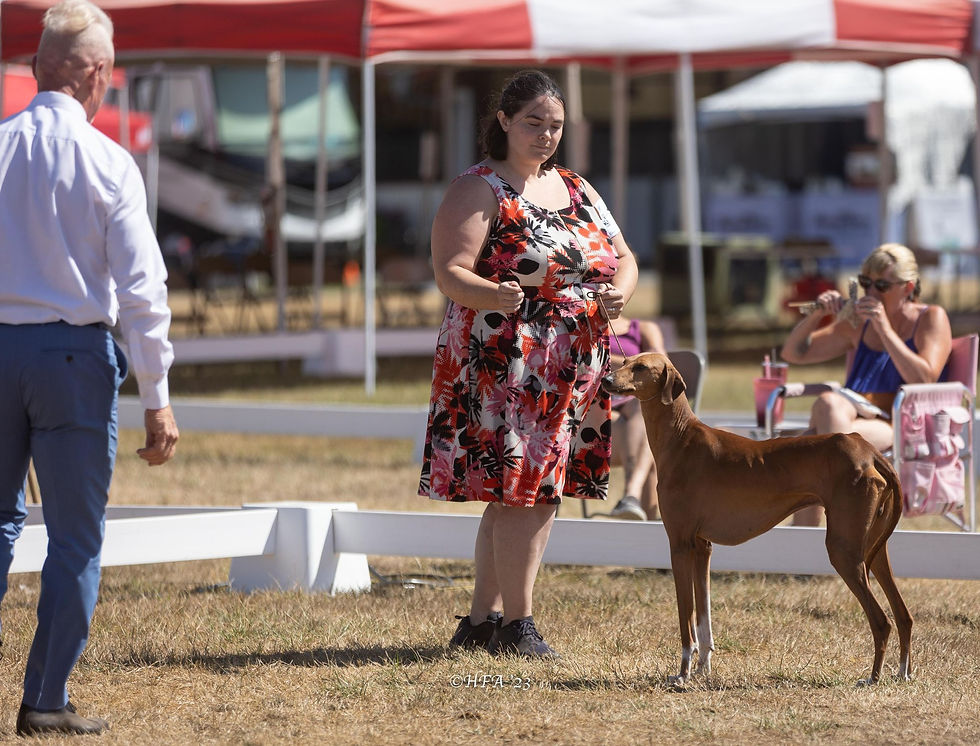
Professional handlers make a judge's life easier. In a sea of a thousand variables to consider in the ring a professional handler equalizes a lot of those variables. They know the pattern, they know the expectations, and they perform them without support from the judge. They also tend to be highly skilled at presentation, as it's their job. A skilled owner-handler or breeder-owner-handler can be equal in presentation, again making a judge's life easier.
It is the dogs that don't present themselves well that pose a much greater challenge. Lack of polished presentation could be caused by many things- dog age, development, dog experience level, handler experience level. Certainly I've encountered judges who are annoyed by this; judges who forget what it is like to have a green puppy or a dog who is simply having a bad day. But, by and large, I believe judges want to help. Unfortunately, sometimes their instincts to help lead instead to more complications for dog and exhibitor rather than fewer. That's the subject I want to address. From a canine behavior stand point how can judges best support dog and handler?
One thing that even within the dog training world isn't discussed often enough is how dogs respond to various types of pressure. Very early on in my blog I wrote a post about types of pressure. It was very brief, but it covered a variety of types and I think there is a tendency both from judges and long-time exhibitors to forget how much pressure dog shows put on both dog and handler. And again I don't think that's malicious, but it does seem to be forgotten relatively often and sometimes I think it's perhaps a concept that was never consciously learned.
The big pressures within dog shows are spatial and social pressure. I want to cover both and I want to cover how judges can actually help the dog get through the exam. Then I do want to cover pitfalls that I have seen very often that are well-intentioned but ultimately make the dog and often the handler's job much more difficult.
Spatial pressure is one of those that we see daily and we don't think about it. It might just look like a dog that's not willing to go into corners of the room or hesitates or bolts through doors. Spatial pressure comes from the world around you. If someone walks up to you and gets right up next to you like within an inch of you, typically your natural response is going to be to yield to that pressure to take a step away. And, there are times where we as humans have to not yield to that pressure; where we consciously learn that we need to stand still even though we're very very close to other people. I chaperoned for the school field trip in the fall and I was blown away by how close and jam-packed schools are. It put in perspective why a lot of times children have a hard time learning about giving people their own space in their own bubble.
When this is all translated to the dog world, we need to teach dogs that the exam is a time when they need to not give way to the special pressure. Now, we have breeds that have been purposely bred to push through spatial pressure. A lot of those breeds are breeds that have been bred to break trail or break through snow or ice. You also have breeds like Livestock Guardians who are bred to stand their ground against really intense predator pressure. And in those cases those dogs are going to be a lot more likely to stand up pretty easily. Now, with Livestock Guardians you also have to compete with the sensible suspicion which comes with those types of breeds and that's a different topic that I’ll address further on. However, with most breeds designed to break trail making yourself very neutral and if the dog is starting to get over excited and move into you taking off the pressure stepping back and allowing the handler to reset and then approaching without making any eye contact or doing anything to excite the dog is what is going to get that really wiggly, excitable dog through the exam. Of course in those breeds with our specials we expect them to have worked through those wiggles but especially young class animals it's something that I see all the time when I watch sporting breeds. Beyond that though, sporting dogs are typically straight forward.
I tend to work more often as a trainer with breeds that are sensitive to pressure and don't want to stand up. What I can tell you from a decade of very intensive experience is that the more pressure you put on the dog the more they are going to shrink away. This is where we run into judges truly wanting to help dog and handler but not understanding pressure sensitivity. So often the judges will apply more and more pressure and just either stand there and pet the dog (usually despite the dog’s clear increasing discomfort) or start talking to the dog in a baby tone. The do this because they want to make the dog be at ease, but what's really happening is they are adding more and more spatial pressure by petting or by leaning down and trying to get on the dog’s levels and the dogs are increasingly going to shy away from that. And, if you have a guardian breed or anything any breed with any type of guarding instincts you're also increasing their suspicion level.
So what can you do to help? You can be very businesslike about the interaction. Typically address the handler start at the side of the head or under the chin or on the side of the neck, work yourself down the dog and then back up. It's really helpful to maintain contact on the dog the entire time. A lot of dogs that are pressure sensitive will settle once you've made initial contact and they'll stand okay, but if you pull your hands off and then come back in to feel something else or feel the testicles at that point you're adding more and unexpected spatial pressure and because usually the handler is holding their head forward the dog can't whether the exam is completed or not if you break contact with the dog. This change in the dog’s expectations in more than just a change of expected pattern - you've broken the social contract that these dogs have been trained to expect. Dogs who are sensitive to spatial pressure or social pressure are trained to expect a pattern and dogs that are not inherently in love with being restrained and handled understand the expectations- stand for exam and then the reward is release from spatial and social pressure. However, with these dogs, the second that you take your hands off, the dog expects to be done, and by reaching out again, you've broken their trust.
That transitions us very smoothly into social pressure. There are spatially sensitive dogs that aren't necessarily socially sensitive. Herding breeds and some of your hounds come to mind and in many of those cases the big thing is you train them to the situation, you train them to the pattern, and from there it's usually straightforward. Especially with your adolescent dogs there might be ups and downs, but once they understand the pattern, especially sensitive dogs that don't have guarding instinct usually are very predictable. Where show training becomes even more difficult is when you are working with dogs that also don't enjoy or appreciate social pressure. These are typically dogs in your Working Group, some of your Non-Sporting group – a lot of the more primitive dogs in that group or not necessarily going to be best friends without every strange human they meet. Then within the Hound group you also have Azawakh and Sloughis and to a lesser extent Afghan Hounds (and I am sure some people would make the argument for Salukis as well), where you have a guarding or watchdog component that makes the dog wary of strangers in their space.
This wariness is what we, as handlers who are presenting these breeds to you as judges, have to work through. These dogs don't naturally come with a gregarious outgoing personality. It doesn't matter how often we take them to Home Depot or Lowe's or whatever socialization experience you want to recommend. These dogs, by their nature, by their intended purpose, are not excited about strangers touching them. Showing and standing for exam in particular, is a job for many of these dogs. Being examined is a job for any breed with any variety of guarding or watchdog instinct – it’s not a fun time to be pet, or time to become friends with the judge.

It is unusually common for judges to approach, staring the dog in the eyes, and then cup the dogs head in their hands. I say unusually, because under ordinary circumstances, this isn’t how we would encourage a member of the general public to approach a dog. Yes, show dogs have a higher general level of expected tolerance. However, as someone who has dedicated my life to canine behavior, that particular approach seems a particularly strange choice. Similarly, judges who, against Kennel Club guidance, choose to show the bite themselves. Will many dogs tolerate it or even not mind? Yes. But from both a sanitary perspective and a perspective of granting our dogs and handlers grave and dignity, it seems the less than ideal choice. I have met many a judge who was excellent at coaching novice exhibitors through what they need to see of the dog’s teeth, and that ability to coach without demeaning is a skill I value highly in judges.
At our National Specialty this year, I so appreciated the judge. I was handling my Open Bitch who had taken Winners and the judge was looking at Winner’s Dog and Winner’s Bitch in the Best of Breed ring at the very end of the lineup. She approached the Winner's Dog who was ahead of me and I heard the judge ask for permission to touch the dog again and give the handler time to set the dog up. The handler set up for the exam, the dog stood great. The judge came back to me and went through the same routine. It was so appreciated, because I could set my dog up and help her understand that I need her to do her job again, even though the time it was happening looked different. It looked different, it was a different pattern, but the piece where we set up for exam is the same, and both dogs who were reasonably young and green to the ring tolerated extremely well. Most judges would not have recognized that the change in routine would have thrown off many young, primitive dogs, but because the judge understood the breed everything proceeded easily.
Most exhibitors are very cognizant that it is not a judge's job to get a dog through the exam when we haven't done the prep work. I do think many exhibitors would appreciate judges assuming the best of us by assuming that we have done the prep work but on that particular day, the dog is just struggling. Yes, handling class is useful, certainly, but it is only adjacent to the real ring experience.
For exhibitors, and for that matter for judges who teach confirmation classes, I think expanding on how to work with both spatial pressure and social pressure is very helpful. I have certainly seen many handling instructors do the conga line: you have a line of people and you approach a dog and at first you just approach and every single person approaches and then you approach and reach and every single person does the same and then you approach and reach and just touch the shoulder or side of the neck and every single person does the same. It's a form of desensitization and because it's done in stages, if it is done correctly, the dog is usually not too overwhelmed. It might take several sessions to get to the point where the dog is actually standing for exam, but that is a good example of a way to work with social pressurepatial pressure to an extent as well. The ways that I have seen be very successful working with both spatial and social pressure.
Another way I utilize to work on spatial pressure is to take some type of item so it can be a length of PVC pipe or a broom or a mop and ask your dog to stand/stay. Slowly move that object not touching the dog but up and over and around and behind the dog. Every time the dog starts to move, back off the pressure until the point where the dog can be successful. You should reward intermittently as the dog is successful at this. When you do something like this, you are creating a inherently suspicious and strange situation and you are teaching the dog how to handle pressure from all directional quadrants. This effectively and methodically proofs the dog’s stand/stay. In this case you're proofing your stand/stay to specifically hold up under spatial pressure (ie a hands on exam). Once a dog is successful with pressure near them, I will gently touch their sides the backs of their legs with the object.
Another way that you can work on pressure sensitivity is by elevating the dog physically. That can be as simple as a Cato Board or a Klimb or it can be putting a ground breed up on a ramp or, with puppies, I will sometimes put them on the table. Certainly, yes, they need to learn how to be examined on the ground. But, especially when it is a young dog that's not fully grown, if you elevate their position so that there is less spatial pressure when you're bending over them for exam, it is easier to get them to stand for exam and proof that stand for exam. Then I’ll transition them to the ground.
One of the judges that has impressed me the most in my career showing was not actually one I showed to personally. We had a puppy owner to take their boy to B-Match. He is very traditional in temperament where he is skeptical of strangers touching him. The judge, because it was a match and because they did have time, had them set him up. They got through the exam, but it wasn't pretty, so the judge put the dog on the ramp. To my knowledge, the dog had never been on a ramp. He'd been on a table when I had stacked him as a puppy, but he hadn't been on a ramp. But he took to it immediately and he stacked on it, the judged examined him, and it was night and day different with how well the dog stood. In between each exam, the judge had the handler do the down and back, and then come back and set the dog back up. From a behavior standpoint, you are rewarding the dog with release from pressure by allowing them to do a down and back before asking them to tolerate pressure again. Movement for dogs that are socially and spatially sensitive is often a huge reward, and it's honestly how a lot of us get through showing. Finally, the judge had this handler set the dog up on the ground again and it was a fantastic exam. The dog stood, did a down and back without being suspicious coming back to the judge, then moved really nicely on the around. It genuinely was a make or break experience for that dog's career and I think did. It made the dog and the handler successful. Again that was a B-Match and it was a small match at that, so the judge could take the time to do that. I understand that's not typical, but that is something that we can work in handling class and lessons outside of the show ring.
The last two things that I want to talk about handling for the exam: first how the exhibitor restrains for exam and then I want to discuss the use of any type of bait (whether it be food or toy) in the ring.
I think a lot of judges have been pro-handlers. A lot of judges have handled a lot of dogs. And those judges know what worked for their dogs. So, when they make suggestions on technique to handlers, it is intended to be helpful. But, what I can say is that in your two minutes of judging, there's simply no way for you to know what the handler has tried with this dog and what has been successful and what has failed. You might make a suggestion really truly intending to be kind and help the exhibitor be successful and that might be the worst possible thing for the handler to do for that dog. Potentially the dog had a really bad experience when being restrained or set up in that way. Perhaps that experience was so impactful that the only way to get the dog to stand for exam was to hold them differently. You don't know that. You can't know that. And, when you make suggestions, there is a power imbalance. Your handlers are either going to advocate for themselves and say “I appreciate that, but unfortunately it doesn't work for this dog.” Or, they are going to try your suggestion anyway because you have the power and when you ask them to try something and it might go horribly badly, but it might be okay, you might get through it, or you might not.
One of the examples that I've seen most often is how handlers restrain the dogs head. I think this is one place where it would be very helpful for judges choose to examine expression during the down and back rather than during the exam. Any dog that is at all spatially or socially sensitive, or even dogs that are overly social, are not going to give you proper expression while your hands are on them. The down and back provides a beautiful place for you to get what you need as far as expression. If you're also looking for silhouette at that time, you're welcome to move so you can also see the silhouette and so you can get both expression and silhouette in the same package. But, trying to get expression while you are hands on, in my experience as both a trainer and a handler of my own dogs, is a losing battle.
Is how I got my then 14 month old (left) through the exam the most elegant? No but she took Best of Breed that day over her mother (right) who is much easier to show.
I have especially recently had the pleasure of working with some dogs who had extremely traumatic experiences whether in the ring or restrained social interactions outside of the ring. These are dogs that I really enjoy working with and with whom I’ve largely been extremely successful. One of the biggest things that I have seen make a difference is changing how the dog is set up for examination. The most common change that we have made is the handler pivoting to hold to face the dog and hold the dog on either side of their head facing the dog. This allows them to center the dog’s head and ground them so they're not sinking back. The handler can maintain eye contact and engagement with their dog through really challenging exams. It certainly doesn't work for everyone. It's something that is done with a lot of Basenjis on the table, because again it helps the dog keep connection with their handler and it keeps them grounded and not melting. It's not a traditional way to present your dog in a lot of breeds. But it has become very standard in Basenjis. In Border Collies, you don't typically see it. But, if that is how the dog and handler can be successful, there is nothing wrong with it.
I've also worked a dog that as a young dog before they've been imported at 6 months (because of the CDC guidelines) had been repeatedly snuck up on from behind and slung across their shoulders like a sack of potatoes. It was something where the people interacting with the dog thought was funny and fun but the dog found it deeply traumatic. It took us awhile to understand what that dog's exact trigger was. She was never a bite risk; she just wanted to melt or run away, but the trigger was less traditional and thus was harder to work through. In that case, the handler has to essentially hold the collar while the rest of their body is near the rear of the dog so that the dog feels comfortable that no one is going to sneak up behind her and grab her. It's not traditional. The head is very loosely held. But the dog is perfectly comfortable with that and it's what works for the dog. From a training perspective, we're working hard not needing to put quite as much “protection” behind the dog, but if the dog can get in the ring and be successful and earn points being presented that way again there's nothing wrong.
You, as judges, only see a fraction of a moment of that dog's life. That's why it's so important for handlers to present the dog as best they can. And if that presentation looks different than you're expecting, that's not hurting anything as long as the dog is being presented to look their best.
The last thing that I want to talk about is that especially with socially sensitive dogs, the use of food or toys to distract in the ring can backfire. I have many cases that I've worked where the dogs had been successfully shown by putting bait (or a toy) in front of them. Perhaps for the first exam, the dog took the bait and ignored the exam. Perhaps for fifty times, the dog took the bait and ignored the exam. But eventually, a spatially and/or socially sensitive dog wakes up and realizes they’ve been tricked and they tune in and suddenly someone is very up close and personal and they get very explosively uncomfortable. This is extremely common in the more primitive breeds. I highly recommend against using bait to distract a dog with most primitive breeds because eventually, your bait isn’t going to be high enough value to compensate for a stranger being up in their business. In many of those cases, the dogs are minimally restrained and when they panic, bad things can happen. With these dogs, I spend a lot of time training a restrained exam and then rewarding with food at the end. Bribing a primitive or guardian breed will often, eventually backfire.
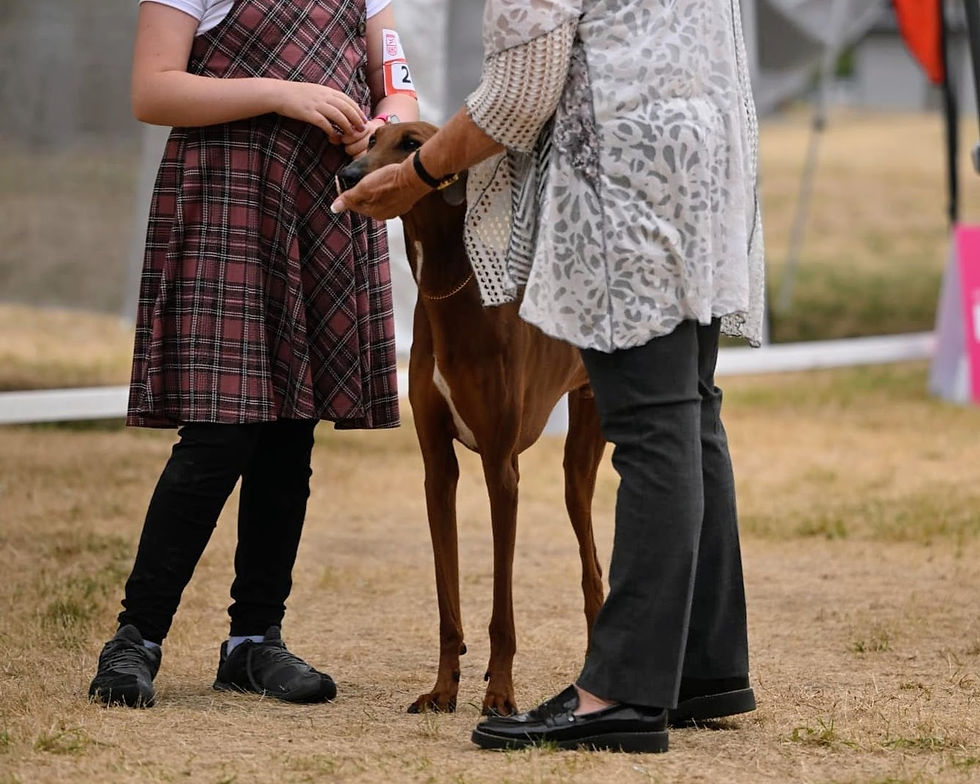
I have spoken with many judges who get exasperated at temperaments. Why can’t the dogs simply be trained to accept everything? Why do they look like they don’t enjoy the exam? Why don’t they have that “It” Factor? Ultimately, is the breed supposed to? If an Akita behaves like a Golden Retriever, is that preferred? Ideal? If an Azawakh acts like a Beagle, is that correct? If that what we should expect of the breed? Certainly, there are exceptions within a breed – dogs that love to show when most of their breed don’t. I don’t suggest punishing them, but if it is a stoic breed, rewarding a gregarious nature because they are gregarious seems to do the breed a disservice.
I work often with many of the Foundation Stock Service breeds (and some that aren’t even FSS). Many (though not all) of those breeds, as well as many low entry fully recognized breeds, are rare for a reason. Many of those breeds have perfectly lovely, suitable homes out there for them in much fewer numbers than the homes suitable for the breeds that make up the AKC Top 10 in Popularity. That doesn’t make those breeds ill suited to the modern world, it makes them suited to a particular subset of the general population (which is true of every single breed (I’d be a horrible home for a Labrador Retriever for instance)). The owners, breeders, and exhibitors of this breed have so many more hurdles to overcome than outgoing, gregarious breeds because the nature of dog shows is often the antithesis of their natural temperament. Beyond that, with many of our rare breeds, their chances to actually enter the show ring are greatly curtailed compared to a fully recognized breed. Is it any wonder the dog that only gets six weekends a year to show is less polished than your special who is out every weekend?
The long and the short of this is that I truly believe judges wish dogs and exhibitors to be successful and the best way to do that is to grant the handlers the grace of assuming they’ve put in the work (the dog or handler is just having an off day) and approach the exam softly, calmly, and without trying to make friends with the dog you’re examining.


Comments